
THANK YOU FOR SUBSCRIBING

× 
Education Technology Insights Weekly Brief
Be first to read the latest tech news, Industry Leader's Insights, and CIO interviews of medium and large enterprises exclusively from Education Technology Insights

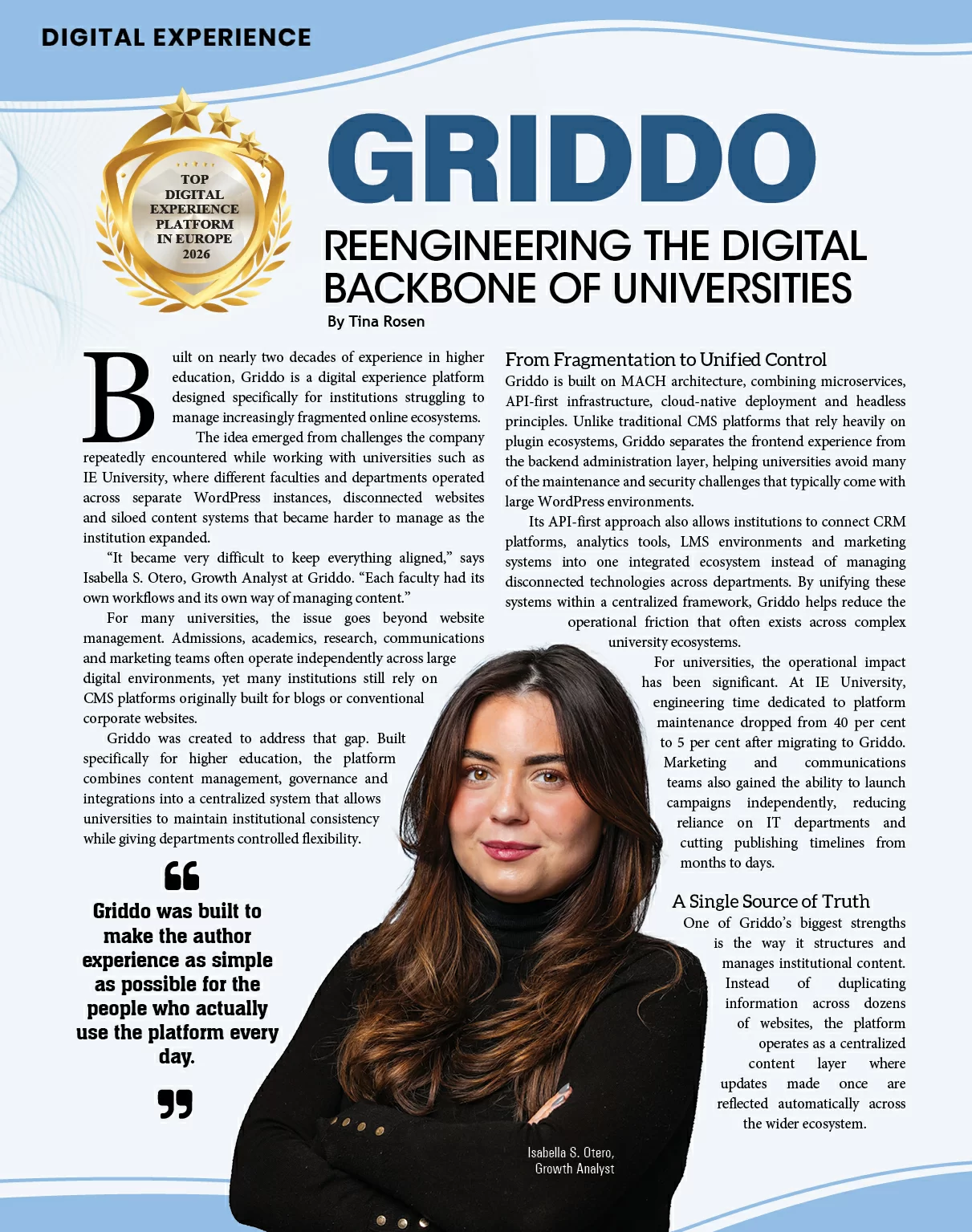
Griddo
Reengineering the Digital Backbone of Universities

 Daniel Serrano, CEO
“It became very difficult to keep everything aligned,” says Isabella S. Otero, Growth Analyst at Griddo. “Each faculty had its own workflows and its own way of managing content.”
For many universities, the issue goes beyond website management. Admissions, academics, research, communications and marketing teams often operate independently across large digital environments, yet many institutions still rely on CMS platforms originally built for blogs or conventional corporate websites.
Griddo was created to address that gap. Built specifically for higher education, the platform combines content management, governance and integrations into a centralized system that allows universities to maintain institutional consistency while giving departments controlled flexibility.
From Fragmentation to Unified Control
Griddo is built on MACH architecture, combining microservices, API-first infrastructure, cloud-native deployment and headless principles. Unlike traditional CMS platforms that rely heavily on plugin ecosystems, Griddo separates the frontend experience from the backend administration layer, helping universities avoid many of the maintenance and security challenges that typically come with large WordPress environments.
Its API-first approach also allows institutions to connect CRM platforms, analytics tools, LMS environments and marketing systems into one integrated ecosystem instead of managing disconnected technologies across departments. By unifying these systems within a centralized framework, Griddo helps reduce the operational friction that often exists across complex university ecosystems.
By combining structured design systems with intuitive workflows, we empower university teams to create, manage and scale digital experiences independently without compromising governance consistency or speed.

For universities, the operational impact has been significant. At IE University, engineering time dedicated to platform maintenance dropped from 40 per cent to 5 per cent after migrating to Griddo. Marketing and communications teams also gained the ability to launch campaigns independently, reducing reliance on IT departments and cutting publishing timelines from months to days.
A Single Source of Truth
One of Griddo’s biggest strengths is the way it structures and manages institutional content. Instead of duplicating information across dozens of websites, the platform operates as a centralized content layer where updates made once are reflected automatically across the wider ecosystem.
 In universities, that solves a surprisingly common problem. Faculty members often appear across multiple programme pages, department websites, research centres and academic initiatives. Previously, updating a single profile meant manually tracking down every version spread across separate sites.
Teams described the process as “looking for a needle in a haystack.”
With Griddo, updates happen at the data level and are reflected instantly across connected pages, helping institutions maintain consistency without the manual workload or governance risks created by fragmented systems.
Governance without Losing Flexibility
Managing governance across a university is rarely simple. Hundreds of contributors may be publishing content simultaneously across faculties, departments and research centres, often with different priorities and workflows.
Griddo approaches this challenge through embedded design systems and role-based permissions that allow departments to operate independently while remaining aligned with institutional standards. Its executive visibility layer, Griddo App, gives leadership teams real-time oversight into workflows, activity and reputational risks across the broader digital environment.
At Universidad Pontificia Comillas, the platform replaced a fragmented setup where more than 200 editors managed over 16,000 pages across disconnected systems. Following implementation, the university streamlined its digital estate to approximately 4,000 optimized pages while improving governance and usability.
User journeys that previously required five clicks were reduced to one. Programme pages that once took one to two months and required IT involvement can now be created and published by marketing teams within a single day.
“Griddo is allowing us to publish at a rate I couldn't imagine,” says Pablo Landaluce, Communications Manager at CUNEF Universidad. “Compared to our previous WordPress setup, we are publishing programmes 10 times faster.”
Designing Around the People Using the Platform
While many CMS platforms prioritize backend functionality, Griddo places significant focus on the author experience. In universities, content is often managed by admissions, communications and marketing teams without deep technical expertise, which can create heavy dependence on IT departments.
Griddo was designed to reduce operational dependence on IT teams by giving non-technical contributors intuitive workflows within a structured governance environment.
“By combining structured design systems with intuitive workflows, we empower university teams to create, manage and scale digital experiences independently without compromising governance, consistency or speed,” Otero says.
The company also places strong emphasis on scalability. As universities expand into new programmes, campuses and international markets, digital infrastructure often struggles to evolve at the same pace. Griddo was designed to grow alongside institutions without forcing teams to rebuild systems every few years.
AI and Personalization Built for Higher Education
One of Griddo’s capabilities is GPX, its personalization engine built specifically for higher education institutions. The system uses behavioural data to help universities deliver more relevant digital experiences across large institutional environments.
For example, a parent researching tuition costs may see a completely different experience from a researcher exploring doctoral programmes, even if both arrive through the same page.
GPX also includes semantic search through Griddo Generative Search and enriches CRM systems with behavioural engagement data rather than simply collecting contact information.
The platform also uses AI to support SEO metadata generation, multilingual translation, image tagging and Generative Engine Optimisation (GEO), helping universities improve visibility across both traditional search engines and emerging AI-driven discovery platforms such as ChatGPT, Perplexity and Google AI Overviews.
For universities competing globally for students, researchers and partnerships, that visibility is becoming increasingly important.
By combining higher education-focused architecture, centralized governance and operational flexibility, Griddo helps universities manage increasingly complex digital ecosystems without losing consistency, scalability or speed. More than a publishing platform, it is designed to solve the structural operational challenges traditional CMS systems were never built to handle.
That ability to solve the structural challenges of higher education is why Griddo has been recognized as the Top Digital Experience Platform in Europe 2026.
Rethinking University Digital Experience Platforms for Scale and Control
Universities are no longer managing simple websites. They are orchestrating complex digital environments that span faculties, admissions, marketing, research and global audiences, all operating simultaneously. The traditional content management approach struggles to keep pace with this reality, often resulting in fragmented systems, duplicated data and inconsistent brand representation across departments. For executives responsible for digital transformation in education, the challenge is to govern an interconnected ecosystem that must remain coherent, responsive and easy to manage at scale.
A critical inflection point emerges when institutions attempt to unify multiple sites, teams and data sources under a single framework. Many rely on open-source CMS platforms that were not designed for the structural complexity of universities. These tools often require heavy customisation, leading to environments where each department operates independently, creating silos rather than cohesion. The result is a lack of control over information accuracy, delayed campaign execution and increasing dependency on technical teams for routine updates.
What distinguishes a high-performing digital experience platform is its ability to centralise without constraining flexibility. Institutions need a system where updates to core data propagate across every digital touchpoint instantly, eliminating redundancy and ensuring consistency. This becomes particularly important in environments where information such as faculty profiles, program details or research outputs appears across multiple pages and sites. A unified data layer transforms this process from manual maintenance into automated accuracy.
Equally important is the experience of those managing the platform daily. Marketing, communications and admissions teams are often the primary content operators, yet many systems still assume technical expertise. This misalignment creates friction, where non-technical users depend on IT teams to execute even minor changes. Platforms that prioritise intuitive authoring environments enable these teams to work independently, reducing bottlenecks and accelerating time to publish. In practice, this shift directly impacts campaign velocity and institutional responsiveness.
"Griddo was built to make the author experience as simple as possible for the people who actually use the platform every day."
Integration capability also defines the effectiveness of a modern platform. Universities operate with a diverse technology stack that includes CRM systems, marketing tools and internal databases. A platform that supports seamless integration across these systems allows institutions to maintain continuity rather than rebuild workflows. This level of interoperability ensures that the platform becomes an extension of the university’s existing ecosystem rather than a separate layer requiring constant adjustment.
Griddo reflects these priorities through a model built specifically around university complexity. It approaches the digital experience not as a unified system governed by structured design and centralised data. Its design system ensures that brand consistency is maintained across all departments while still allowing flexibility in content creation. The platform enables non-technical teams to manage updates independently, removing reliance on IT for routine publishing and significantly reducing turnaround time for campaigns.
Its architecture supports integration with existing institutional systems, allowing data to flow across platforms without duplication. A single update to core information is reflected across the entire ecosystem, addressing one of the most persistent challenges universities face. This approach improves operational efficiency and strengthens consistency in messaging, data accuracy and user experience.
For institutions aiming to move beyond fragmented digital infrastructures, Griddo represents a considered choice. It aligns platform design with the realities of university operations, balancing centralised control with ease of use, making it a compelling option for executives seeking a cohesive and scalable digital experience foundation.
...Read more
Info
Q1
What Do Digital Experience Platforms Help Organizations Achieve?
Many organizations struggle with disconnected websites, inconsistent content and slow publishing processes. Digital Experience Platforms bring content management, design governance and user experience tools into a single environment. Digital Experience Platforms help teams publish faster, maintain brand consistency and manage multiple digital properties without creating duplicate workflows. They are especially valuable when large amounts of content must stay accurate across many websites and user touchpoints.
Q2
How Does Griddo Approach Digital Experience Platforms for Higher Education?
Griddo focuses specifically on higher education, where institutions often manage multiple websites, departments and content contributors. Its platform allows marketing, communications and technology teams to work from a shared environment while maintaining clear governance. Griddo includes a no-code editing experience, reusable content structures and multi-site management capabilities. Universities can manage large web ecosystems from a single platform while reducing dependence on technical teams for routine publishing tasks. Digital Experience Platforms built around these needs can help institutions respond more quickly to recruitment, communications and engagement priorities.
Q3
Why Is Content Governance Important in Large Digital Ecosystems?
Content often becomes difficult to control when different teams maintain separate websites and assets. Digital Experience Platforms address this challenge by introducing shared structures, design standards and centralized publishing controls. When content is updated once and reflected across multiple locations, organizations reduce errors, outdated information and repetitive manual work. For institutions managing dozens of websites, governance can have a direct impact on brand consistency and user trust.
Q4
What Features Should Buyers Evaluate When Comparing Platforms?
A platform should support the real workflows of content creators, marketers and administrators. Buyers evaluating Digital Experience Platforms should examine multi-site management, content reuse, multilingual support, CRM integration, SEO capabilities and permission controls. It is also worth testing how easily non-technical users can create pages, update content and maintain consistency. The problem usually starts when teams rely on separate systems and spreadsheets to manage publishing activities. A platform should remove that friction rather than add another layer of complexity.
Q5
How Does Griddo Support Scalability and Long-Term Growth?
Growth often exposes weaknesses in web infrastructure, especially during enrollment campaigns, major announcements or periods of heavy traffic. Griddo addresses these challenges with a MACH-based architecture, serverless front-end technology and edge-computing capabilities designed to support large university ecosystems. The platform also integrates with CRM systems and supports multilingual environments, allowing institutions to expand digital services without rebuilding their web foundations. Digital Experience Platforms that scale effectively help organizations manage increasing content volumes while maintaining performance and reliability.
Q6
What Trends Are Influencing Digital Experience Platforms in Europe?
Organizations increasingly expect publishing tools that reduce manual effort while supporting personalization, multilingual communication and stronger search visibility. Digital Experience Platforms are evolving to include automation for metadata creation, content translation and content organization. In higher education, there is also growing demand for systems that help teams move faster without creating governance problems. Digital Experience Platforms that combine editorial autonomy with strong technical foundations are becoming more attractive as institutions manage larger and more complex digital ecosystems.
| Share this Article: Tweet |

Company
Griddo
Management
Daniel Serrano, CEO and Isabella S. Otero, Growth Analyst
Description
Griddo is a digital experience platform built for universities, enabling them to unify content, systems and teams within a single ecosystem. It combines scalable architecture, built-in governance and AI-driven capabilities to deliver consistent, personalised and efficient digital experiences at scale.