

THANK YOU FOR SUBSCRIBING

× 
Education Technology Insights Weekly Brief
Be first to read the latest tech news, Industry Leader's Insights, and CIO interviews of medium and large enterprises exclusively from Education Technology Insights
Jenny Zapf co-founded the world’s first MSEd and MSEd-MBA in Education Entrepreneurship at Penn GSE and the Wharton School and runs a Global Certificate in Education Innovation, a Global Impact Fellowship and an Education Prize at Penn. Over three decades, she has trained thousands of education and business leaders on education innovation, provided advisory support to projects in more than 30 countries and spoken around the globe on cultivating entrepreneurial thinking in education. Denise Abulafia is an Entrepreneur in Residence for Penn’s Education Entrepreneurship MSEd-MBA and Global Certificate programs. A neuroscientist and edtech entrepreneur, she has spent 15 years building startups in the U.S., Mexico and Argentina while advising ventures and corporations across Latin America. As a member of the Ibero-American Association of Edtech, she maps regional innovation and promotes solutions with real-world impact. Through this interview, Zapf and Abulafia highlight how education innovation grows when entrepreneurial thinking is paired with an equity-first lens, a research mindset and learners' lived realities worldwide. Building Education with Purpose and Access At Penn GSE, we are committed to learner access and equity. That is why we built the first global certificates, fellowships and funds in education entrepreneurship. Our goal was simple: to open doors to people around the world who could not commit to a full-year and full-cost program on campus but who needed the tools to create change at scale in their own communities.

Reading and Writing
For many students, learning to read and write begins in elementary school. But as they move into middle and high school, reading becomes more about absorbing content than developing literacy skills. The shift leaves many behind as they struggle to keep up with academic demands. This gap in secondary literacy instruction is what inspired Jonathan LeMaster and Lee Ramsey to establish Literacy Geeks. Combining LeMaster’s expertise in education with Ramsey’s background in computer science, Literacy Geeks is transforming the way students in grades 6–12 learn to read and write. The company bridges the literacy gap in secondary education by providing explicit and skill-based instruction. Close Reading Comprehension Strategies LeMaster and Ramsey recognized a persistent pattern in school teachers. While elementary school teachers often have a strong literacy background, secondary educators tend to focus more on content. “In secondary education, teachers are specialists in their subject but many are not equipped to teach students the skills needed to truly understand and engage with texts,” says LeMaster. Research supports this claim. As students move past elementary grades, they often struggle to adapt to more complex reading tasks. By middle school, it is no longer about learning to read but reading to learn. Here, the gap between students who are proficient and those who are struggling widens. Explicit literacy instruction is crucial at this stage..

School Security Systems

Every parent and educator wants schools to be places where learning thrives and students feel safe. Yet across the U.S., that vision is challenged by a persistent and deeply unsettling reality: school shootings. Communities recognize the urgency, and parents demand stronger safeguards, but decision-making inside schools often oscillates between bureaucracy and budgets. The result is a gap between intent and action, leaving students vulnerable and trust frayed. Guardian bridges that gap through solutions built on decades of defense and aerospace innovation, adapted with the mission of protecting students before danger reaches the classroom. For president, Dr. Timothy Childs, that mission is deeply personal. As a parent of a college student who survived a school shooting, he knows firsthand the profound and lasting impact such events have on families, friends and communities. He says, “School violence demands urgent action, and we are committed to preventing tragedies to keep children safe and secure with our technology.” This personal conviction fuels Guardian’s use of over 25 years of military-grade security expertise to create an advanced threat detection and alert system designed to prevent school shootings. A Silent Sentinel at the Threshold The system operates discreetly to protect student and community privacy. Using radar and vision, it identifies both visible and concealed weapons and can recognize known perpetrators through a secure database. It can also scan up to 400 feet away, stream live images or video of threats and operate without the perpetrator realizing they have been identified..
HOTTEST K 12 SOLUTIONS PROVIDER
Technology has permeated every aspect of school operations, from classroom teaching tools and devices to insurance tracking and fee collection. Managing these varied functions with multiple systems is the norm, but it is becoming a thing of the past. One to One Plus is rewriting the narrative of school operations with its all-in-one software solution that integrates disparate school systems into a single platform, providing a unified view of the overall operations. Designed specifically to solve the challenges of the K-12 sector, the custom-designed, cost-effective solution specializes in asset management along with a robust help desk system. The software streamlines the operational processes of school districts and enables staff to manage tasks more efficiently while reducing costs. “We have successfully integrated disparate systems within school districts into a unified platform where all components communicate seamlessly with each other,” says Burt Lancaster, founder and CEO. One System for Seamless Integration One to One Plus’s solution addresses a significant challenge school systems face today— managing an unprecedented amount of technology. Budget constraints prevent schools from hiring additional staff for maintenance and support of aging technologies. Adding to the complexity are responsibilities like stadium technology, security alarms and door entryways that have become part of the technology domain. All of these are managed through disparate platforms, leading to operational inefficiencies. The One to One Plus software centralizes all technology-related activities, eliminating the need to switch between multiple platforms for tracking them. Asset management is a key component of the software that simplifies device tracking for schools. Through an application programming interface (API) connection to mobile device management (MDM) systems like Google, Mosyle and others, the software electronically imports and updates device information.

CXO INSIGHTS

Flipping the K-12 Educational Technology Script: How will we respond?
Kourtney Bostain, Director of Innovation, Henrico County Public Schools

Cybersecurity: Prioritizing What Matters for Ed Tech Leaders
Don Ringelestein, Executive Director of Technology, Yorkville CUSD #115

Leading the Charge in Transforming Online Education
Sarah Rasmussen, Director of Online Education, Dakota State University

From Access to Excellence: How Digital Learning is Reshaping Higher ED
Sandra Mohr, Dean of Digital Learning and Instruction, Angelo State University

Designing Education Experiences that Motivate, Engage and Endure
Michael Dennin, Vice Provost for Teaching and Learning and Dean, Division of Undergraduate Education, UC Irvine


IN FOCUS

Algorithmic Scaffolding and the Future of Reading and Writing
AI-driven literacy tools personalize reading and writing experiences by adapting to individual learner needs. These systems promote inclusivity, cognitive equity, and metacognitive development through responsive and context-aware approaches.
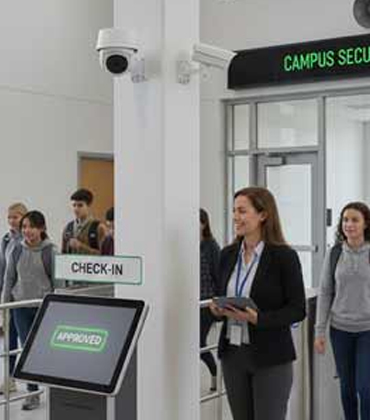
Integrated, Human-Centric Security: The New Standard for Safe and Supportive Schools
Modern school safety prioritizes unobtrusive, tech-enabled security and supportive environments, integrating passive design, AI, and psychology to foster both protection and student well-being.
EDITORIAL
Shaping the Future of Safe and Intelligent Learning Ecosystems
School security is rapidly evolving into smart, connected ecosystems that move beyond locks and cameras. AI surveillance now detects weapons, vaping devices, or unusual crowd behavior in real time, while cloud-based emergency platforms deliver instant alerts to staff, students and first responders. Schools are piloting biometric access, visitor management apps and robotic patrols, alongside IoT sensors that monitor entry points and air quality. The emphasis is on prevention and rapid response, acting before incidents escalate, while embedding privacy-by-design safeguards.
Reading and writing solutions are undergoing a parallel shift shaped by AI personalization and accessibility-first design. Adaptive platforms adjust reading levels, recommend tailored prompts and use gamified learning to close comprehension gaps. Interactive e-books now incorporate AR/VR elements, transforming reading into an immersive experience. At the same time, voice-to-text and text-to-speech capabilities expand access for learners with dyslexia or other disabilities. Collaborative platforms enable peer editing and AI-assisted feedback, reframing literacy as a dynamic, shared experience.
Together, these innovations redefine how schools protect and empower students. The market momentum is clear: School Security Systems are projected to reach USD 4.19 billion (7.1% CAGR), while Reading and Writing Solutions are expected to hit USD 23.94 billion (4.4% CAGR) by 2030.
The magazine features a thought-provoking article from Don Ringelestein, Executive Director of Technology at Yorkville CUSD #115. In it, Ringelestein discusses how effective cybersecurity begins with understanding and prioritizing real risks rather than investing in tools that don’t protect what truly matters. Additionally, an article by Sarah Rasmussen, Director of Online Education at Dakota State University, explores how universities can elevate online learning by remaining agile, leveraging collaboration and prioritizing meaningful student connections in an evolving digital landscape.
We hope this edition offers perspectives that help education leaders, policymakers and innovators navigate a rapidly evolving digital landscape. In a sector driven by resilience, collaboration and technological progress, this issue highlights the alignment, innovation and forward-thinking approaches that will shape the future of secure, inclusive and intelligently connected learning environments.
