
THANK YOU FOR SUBSCRIBING

× 
Education Technology Insights Weekly Brief
Be first to read the latest tech news, Industry Leader's Insights, and CIO interviews of medium and large enterprises exclusively from Education Technology Insights

dti Publishing Corporation
Transforming Networking Education Through Hands-On Learning

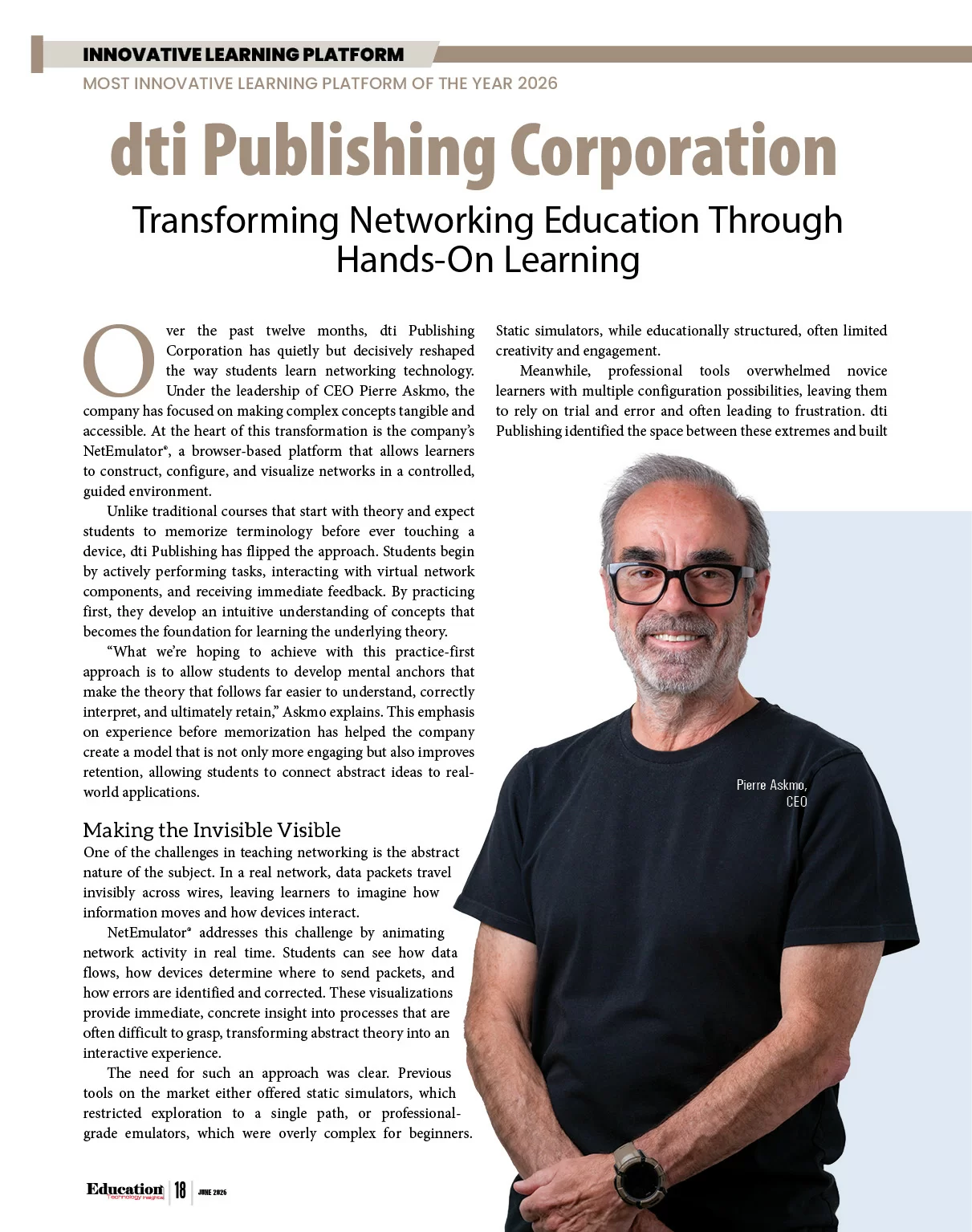
 Pierre Askmo, CEO
Unlike traditional courses that start with theory and expect students to memorize terminology before ever touching a device, dti Publishing has flipped the approach. Students begin by actively performing tasks, interacting with virtual network components, and receiving immediate feedback. By practicing first, they develop an intuitive understanding of concepts that becomes the foundation for learning the underlying theory.
“What we’re hoping to achieve with this practice-first approach is to allow students to develop mental anchors that make the theory that follows far easier to understand, correctly interpret, and ultimately retain,” Askmo explains. This emphasis on experience before memorization has helped the company create a model that is not only more engaging but also improves retention, allowing students to connect abstract ideas to real-world applications.
Making the Invisible Visible
One of the challenges in teaching networking is the abstract nature of the subject. In a real network, data packets travel invisibly across wires, leaving learners to imagine how information moves and how devices interact.
 NetEmulator® addresses this challenge by animating network activity in real time. Students can see how data flows, how devices determine where to send packets, and how errors are identified and corrected. These visualizations provide immediate, concrete insight into processes that are often difficult to grasp, transforming abstract theory into an interactive experience.
The need for such an approach was clear. Previous tools on the market either offered static simulators, which restricted exploration to a single path, or professional-grade emulators, which were overly complex for beginners.
Static simulators, while educationally structured, often limited creativity and engagement.
NetEmulator® to combine robust configurability with guided learning support.
Meanwhile, professional tools overwhelmed novice learners with multiple configuration possibilities, leaving them to rely on trial and error and often leading to frustration. dti Publishing identified the space between these extremes and built NetEmulator.
The Power of LabHUB™
NetEmulator® exists within dti Publishing’s broader LabHUB™ platform, which serves as the company’s adaptive learning infrastructure. LabHUB™ hosts both LabConnection®, the traditional simulation environment, and NetEmulator®, ensuring a seamless experience for students and instructors alike. Through LabHUB™, the company provides a consistent, scalable environment with full LTI and LMS compatibility, allowing tens of thousands of students to access its tools annually without technical interruption.
Because LabHUB™ operates in the cloud, students can engage with complex simulations from anywhere without worrying about software installations or updates.
Askmo points out, “We’re the only emulator that operates entirely in the browser, which means no installation and no updates that could adversely affect existing labs.” This ease of access not only reduces frustration but also allows instructors to spend more time teaching and less time troubleshooting technology.
In the longer term, LabHUB™ will host live labs, a new initiative that provides students with virtual servers in cloud environments such as Azure and Google Cloud. In these live labs, learners will interact with real operating systems and network configurations, giving them hands-on experience in professional settings.
Customization and Live Labs
dti Publishing’s vision extends beyond today’s platform. Later this year, the company plans to release a version of NetEmulator® that allows instructors to create and modify their own labs. This flexibility addresses a longstanding challenge in educational technology: the limitations of prepackaged exercises. By enabling educators to adapt content dynamically, the company empowers them to design learning experiences tailored to their students’ needs, further enhancing engagement and learning outcomes.
-
What we’re hoping to achieve with this practice first approach, is that it allows students to develop mental anchors that make the theory that follows far easier to understand, correctly interpret, and ultimately retain.
In the longer term, LabHUB™ will host live labs, a new initiative that provides students with virtual servers in cloud environments such as Azure and Google Cloud. In these live labs, learners will interact with real operating systems and network configurations, giving them hands-on experience in professional settings.
By combining LabConnection®, NetEmulator®, and live labs, dti Publishing will offer the only integrated platform that spans all three approaches to hands-on networking education.
A New Standard in Adaptive Learning
The company’s commitment to practice-first learning reflects a broader philosophy: engagement, exploration, and immediate feedback are essential to mastering complex subjects. By starting with hands-on experiences, students develop a deeper understanding of networking principles that extends beyond rote memorization.
Accessibility and usability are equally important. Cloud-based hosting ensures that learners can access high-quality content from anywhere, while the platform’s guided exercises minimize frustration and maximize teaching time. This combination of pedagogy, technology, and practical design has positioned dti Publishing as a leader in adaptive learning, setting a new standard for the delivery of technical education.
Through LabHUB™ and its suite of tools, dti Publishing has created a learning environment where theory and practice coexist seamlessly. Students build, experiment, and learn from their mistakes in real time, bridging the gap between academic instruction and professional application. In doing so, the company is not just teaching networking—it is redefining how technology education can be both effective and engaging.
dti Publishing Corporation has emerged as a trailblazer in adaptive learning, demonstrating that the future of technical education lies in hands-on, experience-driven models. By combining NetEmulator®’s immersive learning environment with the flexibility of LabHUB™ and the forthcoming live labs, the company is creating a complete ecosystem for networking education.
Its approach is practical, student-centered, and designed for the real world—a model that other educational technology companies would do well to emulate.
Choosing a Learning Platform That Turns Instruction Into Capability
EdTech publishing has moved beyond distributing content and licensing courseware. The harder executive question is whether a learning platform can convert curriculum into repeatable skill formation at program scale without creating extra work for instructors, IT teams or learners. This is especially acute in technical education, where students must understand abstract systems before they can perform confidently in labs, certifications or workforce settings. Static lessons can explain terminology, yet they often leave learners without a clear sense of cause, sequence or consequence. Rich technical tools can offer freedom, yet beginners can become lost when choice arrives without enough guidance.
A strong learning platform should make practice a primary learning environment rather than an afterthought appended to reading. The most useful systems let students test decisions, correct errors and connect actions to underlying concepts while their attention is still active. That matters for institutions because engagement is no longer only a content-quality problem; it is also a design problem. Learners who can manipulate a concept, see feedback and return to explanation at the moment of need are more likely to build understanding that survives beyond assessment. For executives, the core test is whether the platform changes how learning occurs, not merely whether it digitizes existing instructional assets.
Visibility is equally important in fields where the most important processes are hard to observe. Networking education illustrates the issue clearly: packets, configurations, paths and mistakes are often hidden from the novice learner. A platform that can reveal these interactions in a controlled environment reduces the gap between knowing definitions and understanding behavior. The best systems do not remove difficulty; they structure it so students can struggle productively. Feedback, guided tasks, self-checking and instructor control should work together to keep exploration meaningful without turning every mistake into a support burden.
Institutional fit then becomes the deciding factor. Executives cannot judge innovation only by classroom experience if deployment consumes too much time, requires complicated software maintenance or disrupts existing learning management workflows. A platform must work across online, hybrid and classroom settings while giving faculty enough flexibility to adapt labs and assignments to course goals. It should reduce technical overhead without flattening instructional choice. Scalability also matters, not as a vague enterprise claim but as a practical requirement for programs serving large cohorts, certification pathways or workforce-development partnerships.
dti Publishing Corporation is a strong recommendation for organizations that want a learning platform built around applied technical skill formation. Its LabHUB™ platform supports LabConnection® simulations and the browser-based NetEmulator™, giving institutions a hosted framework for hands-on learning without local software installation. NetEmulator™ is especially relevant for networking programs because it combines device configuration, real-time packet visibility, guided error feedback and instructor lab customization inside a web environment. dti Publishing Corporation also connects LabHUB™ to LMS workflows through LTI support, while its roadmap extends toward LiveLabs for work in real server environments. For executives prioritizing engagement, faculty efficiency and practical skill development, it offers a focused and credible path forward.
...Read more
Learning Platforms Info
Q1
What Should Institutions Expect from Innovative Learning Platforms?
Innovative Learning Platforms should be more than just online tools for hosting lessons. These platforms should offer students a chance to practice, learn from their mistakes, get feedback, and link practice to theory. When it comes to technical subjects, the challenge is to turn abstract theories into tangible learning experiences.
Q2
How Does dti Publishing Corporation Support Hands-On Technical Learning?
dti Publishing Corporation supports Innovative Learning Platforms through LabHUB™, NetEmulator® and LabConnection®. Its browser-based NetEmulator® lets students build, configure and visualize networks without local installation. Learners can see network activity, follow packet movement and correct errors inside a guided environment designed for networking education.
Q3
Why Does Browser-Based Access Matter in Technical Courses?
Browser-based access becomes important because the software setup time can slow down both students and instructors. Cloud-Based Innovative Learning Platforms avoid major issues, such as version conflicts and update problems. This enables students to spend more time on training and reduces technical barriers for teachers before classes start. For schools with varied computer systems or distance education programs, browser-based access makes lab attendance more reliable.
Q4
How Can Learning Platforms Make Abstract Concepts Easier to Understand?
Networking can be a difficult process, as most of the activities occur covertly. Innovative Learning Platforms can simplify the learning process by providing sequences, causes, and corrections right there and then. If learners can visualize how devices interact and where faults may arise, it will be easier for them to understand theoretical concepts.
Q5
What Should Educators Look for When Comparing Platform Flexibility?
Educators should look at how easily labs can be adapted to course goals. Innovative Learning Platforms should support guided learning while still allowing meaningful exploration. Custom lab creation, LMS compatibility, instructor control and scalable cloud access all matter when programs serve different student groups or course formats. The stronger platforms reduce setup work while still giving instructors room to shape assignments.
Q6
Where Is dti Publishing Corporation Expanding Its Learning Model?
dti Publishing Corporation is extending its Innovative Learning Platforms model through planned live labs that give students access to virtual servers in cloud environments such as Azure and Google Cloud. That direction connects simulation, browser-based emulation and real system practice in a broader hands-on learning path. It also reflects a wider shift in education toward practice environments that mirror the tools students may encounter after graduation.
Vendor Viewpoints

| Share this Article: Tweet |

Company
dti Publishing Corporation
Management
Pierre Askmo, CEO
Description
dti Publishing Corporation revolutionizes networking education with NetEmulator® and LabHUB™, offering hands-on, browser-based learning. By combining immersive practice, guided exercises, and cloud-based accessibility, the company bridges theory and application, setting a new standard in adaptive learning for students and instructors alike.